Guide
Where is the True Limit of Transformer Architectures?
 Yasin Polat
 the AI · Guide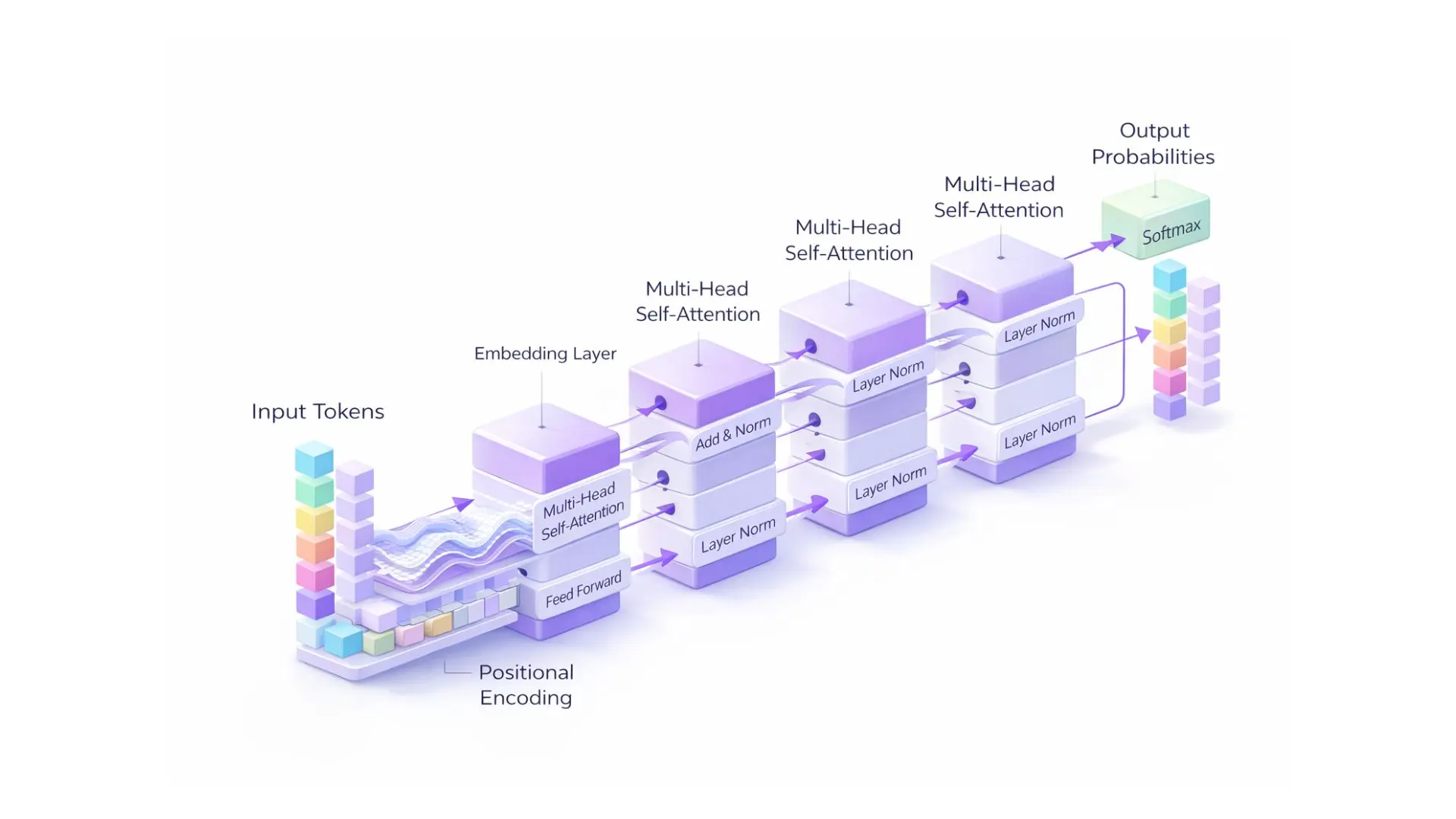
Transformer architectures underpin nearly everything that comes to mind when discussing artificial intelligence today. They generate text, write code, and provide convincing answers to complex questions. Consequently, the following assumption has become widespread: These models now understand (but do they really?).
However, when you work with the same models for a little longer, you notice something peculiar. They can contradict information they stated correctly just a few pages ago. They can silently forget a previously clearly defined rule. In the middle of a long conversation, they can act as if a critical variable discussed at the beginning never existed.
This is where the problem begins. We mistake this behavior for an intelligence issue. But the issue is much more fundamental and slightly more engineering-focused.
To see this difference more concretely, it helps to look at what a Transformer does at each step using very simple pseudo-code.
# This is the simplest and most basic process performed during each token generation
for t in range(len(context)):
Q = W_q @ context[t]
K = W_k @ context
V = W_v @ context
output[t] = softmax(Q @ K.T) @ V
This simple code snippet is a mathematical summary of the Self-Attention mechanism, which forms the basis of modern artificial intelligence (LLM). During processing, each word interacts with each other through a “query” representing itself, ‘keys’ defining other words, and “values” carrying the actual information. Thanks to this triple matrix multiplication, the model calculates the contextual relationship of each word in the sentence with the others and determines how much “attention” it should pay to each word. These interest scores, normalized by the Softmax function, create a new output that represents not only the dictionary meanings of the words but also their deeper meanings (context) within the sentence. In essence, this loop transforms static word lists into a dynamic data structure that understands and interprets each other.
The key point to note here is that there is no persistent state carried over from previous steps in this loop. The entire context is re-evaluated at each step.
The real limitation of Transformers is not how smart they are, but how they are designed.
The Transformer architecture is fundamentally a sequence processing machine. It takes a sequence of tokens as input and calculates the relationships within that sequence. The main mechanism it uses to do this is attention. Simply put, attention is a weighting method that calculates how related each part of the sequence is to the other parts.
What the model does is roughly this: When generating this word, how much should I look at the previous words? This calculation is redone at every step. It is elegant mathematically, powerful computationally, and highly suited for parallel processing. This is the fundamental reason why Transformers spread so quickly.
However, there is a critical detail here. Attention is not a memory mechanism!
Long context windows are perceived as if the model had memory. In reality, the model does not store anything. It simply recalculates on the text presented to it each time.
To see this clearly, let's compare a classic memory mechanism with the Transformer flow side by side.
# Classic stateful system
state = {}
state[“rule”] = “A > B”
# Later
if state[“rule”] == “A > B”:
decision = “use_A”
In this code, we see the classic programming logic where the system maintains a “memory” (state) and decisions are based on predefined rigid rules (if-else). Unlike the Self-Attention code I shared earlier, the system here does not generate new meaning. It only remembers the given set of rules and applies them verbatim.
There is no similar structure on the Transformer side.
# In the Transformer, the rule only exists as a token
context = “A is greater than B”
# This information is not specifically marked
# It is unknown whether it is still valid in the next step
Comparing this to human memory is instructive. When a person learns a piece of information, that information becomes a state in the mind. It is now marked as a valid fact. Subsequent information is interpreted according to this state. Any contradictions are detected.
In Transformers, there is no such concept of state. The model does not retain information given at the beginning of a conversation as a valid rule at the end of the conversation. That information is only there as a sequence of tokens. As new tokens are generated, the validity of old information is not specifically represented within the model.
Here, the usual suggestion is: Let's build a bigger model. Let's add more parameters. Let's increase the context window. This approach seems effective in the short term. Errors are delayed. The model produces more convincing answers. But the problem is not solved.
No matter how big the model is, no matter how many layers and parameters it has, what it does is essentially transform the same text over and over again. Each layer processes the information it has a little more, makes it a little more “smart”. But this process is one-time. When the conversation ends or the context is lost, everything is reset.
What's missing is this: The model has no permanent memory that allows it to say, “I just learned something important, I should remember this.”
Let's use an analogy from everyday life.
Think of a meeting. There are very smart, very experienced people in the room. With each round, they analyze the topic a little better. But if no notes are taken when the meeting ends, everyone has to discuss everything from scratch the next day. People are smart, but there is no record.
This is what happens with large language models. There is intelligence. There is processing power. There is deep analysis. But there is no notebook.
Increasing the number of layers is like bringing more experts into the meeting. The discussion improves. But nothing accumulates unless someone steps up and says, “Let's write this down; this is now permanent knowledge.” Because increasing the number of parameters does not automatically introduce the concept of state. Long context does not produce temporal consistency. More data does not compensate for an architectural deficiency.
That's why even very large models continue to break down in long-chain reasoning. They become inconsistent in multi-step tasks. They can contradict themselves within the same session.
So is there no solution at all?
Derivatives called positional encoding (which I will explain shortly), relative positioning methods, and similar approaches have partially improved this problem. The distance between tokens is now better represented. Performance has improved in long texts.
By the way, positional encoding is a way of asking the model questions like, “Where does this word appear in the text?” Transformers see words individually but naturally have no concept of sequence. They don't inherently understand relationships like “first,” “then,” or “at the beginning.” That's why positional information is added to each word.
However, these methods do not solve the fundamental problem. They correct distance but do not model the continuity of meaning. They still do not represent when information becomes valid or when it becomes invalid.
This is where the real limitation becomes clear. The fundamental limitation of Transformer architectures is that they cannot inherently model concepts of time, state, and causality. Therefore, these models appear intelligent but are not systematically reliable. They perform impressively on short tasks. They are fragile when faced with long-term, multi-step, and state-dependent problems.
This is not an intelligence deficiency. It is an architectural deficiency. The future lies not only in larger Transformers. The real need is for systems with explicit state representation layers, supported by persistent memory mechanisms, and treating time as a real dimension.
Large language models are not intelligence on their own. However, they can be a powerful component within state-bearing systems.
The real question now is: How intelligent is this model? How does this system carry state, how does it handle time, and how does it know what it must not forget?
Any scaling done without answering this question will only produce larger but equally fragile systems.
Bültenime Abone Olun
Tüm güncellemeleri doğrudan benden almak için abone ol!